
All AbMole products are for research use only, cannot be used for human consumption.

AZD8931 is an equipotent, reversible inhibitor of Signaling by EGFR, ERBB2 (HER2), and ERBB3 with IC50 of 4, 3, 4 nM, respectively. AZD8931 was significantly more potent than gefitinib or lapatinib in specific squamous cell carcinoma of the head and neck and non–small cell lung carcinoma cell lines. In vivo, AZD8931 inhibited xenograft growth in a range of models while significantly affecting EGFR, erbB2, and erbB3 phosphorylation and downstream signaling pathways, apoptosis, and proliferation. AZD8931 provides the opportunity to investigate whether simultaneous inhibition of erbB receptor signaling could be of utility in the clinic, particularly in the majority of solid tumors that do not overexpress erbB2.
 |
Source | J Exp Clin Cancer Res (2014). Figure 3. AZD8931 |
| Method | MTS assay | |
| Cell Lines | human IBC cells | |
| Concentrations | 1 μmol/L | |
| Incubation Time | 48 or 72 h | |
| Results | AZD8931 significantly suppressed the proliferation of SUM149 cells in a dosedependent manner when compared with the control |
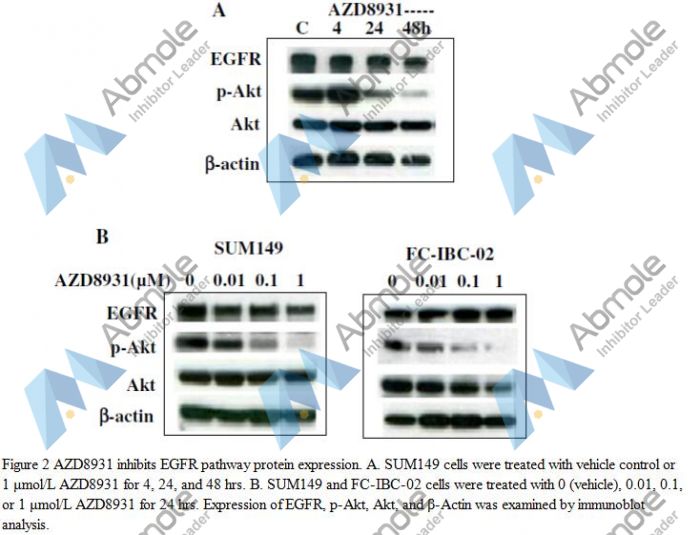 |
Source | J Exp Clin Cancer Res (2014). Figure 2. AZD8931 |
| Method | Western blot | |
| Cell Lines | SUM149 cells | |
| Concentrations | 1 μmol/L | |
| Incubation Time | 4, 24, and 48 h | |
| Results | Western blot analysis showed that AZD8931 had no significant effect on EGFR expression level, and significantly inhibited phosphorylation of Akt in a timedependent manner |
| Cell Experiment | |
|---|---|
| Cell lines | a panel of NSCLC and SCCHN cell lines: KYSE-30, OE21, PE/CA-PJ15, PE/CA-PJ34 (clone C12), PE/CA-PJ41 (clone D2), PE/CA-PJ49, DOK, Detroit562, RPMI2650, SCC-4, SCC-9, SCC-25, CAL 27, SW579, FaDu, Hs 840.T, KB, KYSE-450, and HEp-2, HN5; PC-9, Calu-3, NCI-H2073, NCI-H1623, NCI-H522, NCI-H2085, NCI-H2030, NCI-H1703, NCI-H2291, NCI-H2135, NCI-H1975, NCI-H23, NCI-H1650, NCI-H1437, NCI-H3255, and NCI-H1666 cell lines |
| Preparation method | cell viability assay. To determine their antiproliferative activity against cell lines grown in vitro, AZD8931, gefitinib, and lapatinib were tested in a panel of NSCLC and SCCHN cell lines. Cells were incubated for 96 h with a suitable range of concentrations of drug to ensure accurate estimation of the inhibitor concentration required to give 50% growth inhibition (GI50; typically between 0.001-10 μmol/L). Viable cell number was determined by 4 h of incubation with MTS Colorimetric Assay reagent (Promega) and absorbance measured at 490 nm on a spectrophotometer (Molecular Devices). Each experiment was carried out in triplicate for each drug concentration and data are presented as geometric means. Sensitivity groupings of GI50 data were <1 μmol/L (classed as sensitive), 1 to 7 μmol/L (classed as intermediate), and >7 μmol/L (classed as resistant). |
| Concentrations | 0~10μM |
| Incubation time | 96 h |
| Animal Experiment | |
|---|---|
| Animal models | BT474c, Calu-3, LoVo, FaDu and PC-9 xenograft mouse models |
| Formulation | suspended in a 1% (v/v) solution of polyoxyethylenesorbitan monooleate (Tween 80) in deionized water |
| Dosages | 6.25-50 mg/kg twice daily |
| Administration | oral gavage |
| Molecular Weight | 473.93 |
| Formula | C23H25ClFN5O3 |
| CAS Number | 848942-61-0 |
| Solubility (25°C) | DMSO 40 mg/mL |
| Storage |
Powder -20°C 3 years ; 4°C 2 years In solvent -80°C 6 months ; -20°C 1 month |
| Related EGFR/HER2 Products |
|---|
| AEE788
AEE788 (NVP-AEE788) is a novel multitargeted HER 1/2 and VEGFR 1/2 receptor family tyrosine kinases inhibitor with IC50 of 2, 6, 77, 59 nM for EGFR, ErbB2, KDR, and Flt-1. |
| Afatinib
Afatinib (BIBW 2992) is a novel irreversible dual EGFR and HER2 tyrosine kinase inhibitor. |
| CP-724714
CP-724714 is a potent and selective orally active HER-2 tyrosine kinase inhibitor, IC50 = 3 nM. |
| Erlotinib Hydrochloride
Erlotinib is an inhibitor of human EGFR tyrosine kinase (IC50 = 2 nM) and decreases EGFR autophosphorylation in tumor cells (IC50 = 20 nM). |
| Gefitinib
Gefitinib (ZD1839) is an EGFR tyrosine kinase and Akt phosphorylation inhibitor. Gefitinib significantly down-regulates CD47 expression and increases DC phagocytosis in non-small cell lung cancer cells such as PC9, H1437 and H1573. Gefitinib combined with CD47 antibody can enhance the phagocytosis of macrophages. |
All AbMole products are for research use only, cannot be used for human consumption or veterinary use. We do not provide products or services to individuals. Please comply with the intended use and do not use AbMole products for any other purpose.


Products are for research use only. Not for human use. We do not sell to patients.
© Copyright 2010-2024 AbMole BioScience. All Rights Reserved.
